


Guide
Medialunas vs croissants: what is actually different?
A medialuna is smaller, softer and sweeter than a croissant, and it is glazed with syrup instead of egg. Both are crescent-shaped laminated pastries, and that is roughly where the similarity stops — the doughs are built for two different jobs.
Medialuna or croissant?
| What | Medialuna | Croissant |
|---|---|---|
| Size | Smaller, two to a serving | Larger, one to a serving |
| Dough | Enriched, softer crumb | Lean laminated, flakier |
| Finish | Brushed with syrup while hot | Egg wash, no syrup |
| Sweetness | Sweet | Barely sweet |
| Eaten with | Coffee, at breakfast or at five | Coffee, at breakfast |
The dough is the real difference
A croissant is made from a lean laminated dough: flour, water, yeast, salt and a great deal of butter folded in as sheets. Almost nothing enriches the dough itself, which is what lets the layers separate into that dry, shattering flake.
A medialuna starts from an enriched dough — sugar, eggs and butter worked into the dough as well as folded through it. Enriched dough is heavier and it laminates less dramatically, so the result is soft and slightly chewy where a croissant is crisp and airy. Neither is a failed version of the other; they are two different textures on purpose.
Size, and how many you eat
A croissant is a single-serving pastry. A medialuna is about half the size and is eaten in pairs — an Argentine breakfast is two medialunas and a coffee, and they are sold by the dozen for that reason. If you are planning quantities, count medialunas the way you would count small pastries, not the way you would count croissants.
The finish: syrup against egg wash
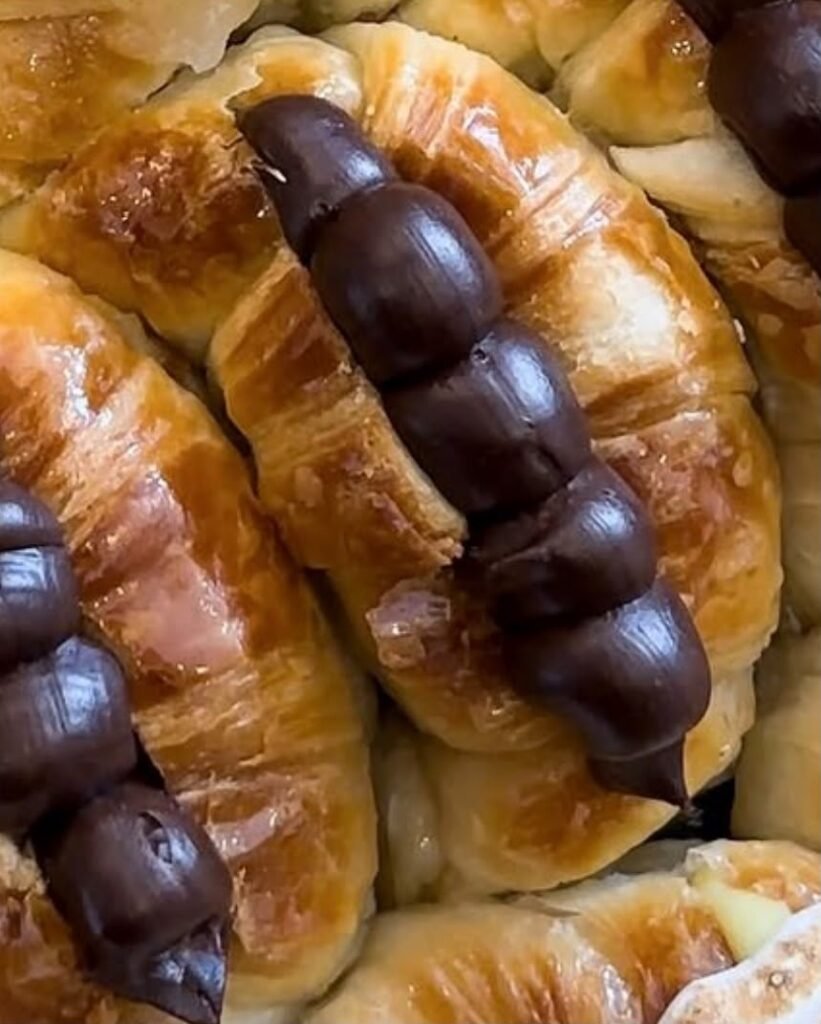
This is the tell. A croissant is brushed with egg before baking, which sets into a matte-to-mid-gloss brown crust. A medialuna is brushed with syrup after baking, while it is still hot, which leaves it shining and very slightly tacky. If your fingers stick a little, it is a medialuna.
Sweetness, and what to serve with each
A croissant is barely sweet, which is why it takes jam or ham without arguing. A medialuna de manteca is sweet on its own, and takes coffee better than it takes a filling of somebody else’s choosing. The Argentine answer to a savoury pastry is the medialuna de grasa, made with lard, which is drier and much less sweet.
The full explanation of the two styles is in what is a medialuna.
Which should you order?
If you want something to build a sandwich on, or you want the dry shatter of a French bakery, order a croissant. If you want the softer, sweeter, glossy thing that goes with coffee and disappears two at a time, order medialunas.
Start with medialunas clásicas if you want to taste the pastry itself, or the caja mixta if you would rather not choose. Everything is in the shop.
How much to order
- Servings
- a dozen serves about 4 people
- Pickup
- Saturday 9:30am–12:00pm
- Orders close
- Thursday 11:59pm
- Allergens
- Eggs, dairy (milk and butter), wheat and gluten, tree nuts (hazelnuts and pistachios) and soy. The weekly rotating special sometimes contains peanuts.
Also being baked

Baked to order, one batch a week
Saturday 3 October